The real estate team of SQUADRA AVOCATS extends its best wishes for the new year 2026 and offers you a legal review of developments from the fourth quarter of 2025.
Legislative developments
Law no. 2025-1129 simplifying town planning and housing law came into force on 28 November 2025
This law aims to:
- Simplify town planning procedures and litigation
- Promote the construction of housing
- Ease the obligation to install solar panels on car parks
Among the noteworthy measures of this law, we note:
- The time limit for filing an informal administrative appeal (recours gracieux) or a hierarchical appeal against a decision relating to a planning authorisation is reduced to one month (instead of two previously) ;
- The filing of an informal administrative appeal no longer extends the time limit for contentious appeals, which must henceforth always be filed within two months of posting ;
- Easing of the obligations to install solar panels on car parks larger than 1,500 sq.m (article 20 of the APER law) through the consideration of "mixed processes" or "renewable energy production devices not requiring shade structures" ;
- The crystallisation of the town planning rules applicable to the initial building permit, for a period of three years, in the context of the examination of an amending building permit.
Towards a framework for commercial rents in urban areas?
While a rent control mechanism already exists for residential leases, no mechanism -apart from the capping mechanism- regulates commercial rents at the stage of concluding commercial leases.
On 14 October 2025, a bill was tabled in the National Assembly by the member of parliament Laurent Lhardit with the aim of establishing a mechanism for controlling commercial rents in order to support and enhance local businesses and to combat their disappearance.
More specifically, this mechanism would apply within the territory of municipalities that have introduced the tax on commercial wastelands, and reference values would be defined by the prefect according to market and location characteristics. Currently, this mechanism is only at the draft stage but could give rise to a pilot scheme.
Bill aiming to support and enhance local businesses, no. 1961, tabled on Tuesday 14 October 2025.
Amendment of the BACS decree timetable by decree no. 2025-1343 of 26 December 2025
Decree no. 2020-887 known as the BACS decree (building automation and control systems), amended by decree no. 2023-259 of 7 April 2023, pursues the objective of equipping all existing and new commercial buildings with automation and control systems.
This decree follows on from the Eco-Energie Tertiaire decree (known as the tertiary decree) by contributing to the achievement of its objectives of reducing energy consumption.
While the BACS decree is already applicable to new buildings and to buildings fitted with equipment of a power exceeding 290 kW since 1 January 2025, buildings fitted with equipment of a power between 70 kW and 290 kW benefited from a time limit until 1 January 2027:
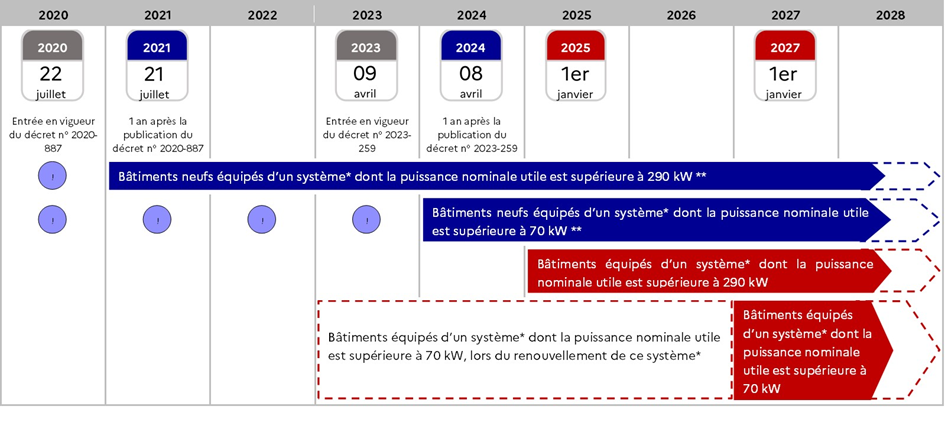
Decree no. 2025-1343 of 26 December 2025 has finally postponed the compliance obligation to 1 January 2030 for existing buildings fitted with equipment of a power between 70 kW and 290 kW.
Case-law developments
Change of use: only the actual allocation to residential use on 1 January 1970 counts
Under the terms of article L. 631-7 of the Construction and Housing Code, premises are deemed to be in residential use within the meaning of this text if they were allocated to such use on 1 January 1970. In the present case, the disputed flat resulted from the merger of two lots:
- one with a surface area of 25 square metres occupied on 1 January 1970 under a commercial lease and without any residential use being established,
- the other, a flat with a surface area of 6 sq.m, in residential use on 1 January 1970,
The Court of Appeal had considered that proof of the residential use of a property with a non-habitable surface area -being less than 9 sq.m- was not sufficient to confer on the premises resulting from the merger of these two premises a residential use on 1 January 1970.
However, the Court of Cassation overturned the decision of the Court of Appeal on the grounds that the allocation of the premises to residential use on 1 January 1970 is understood as the actual allocation of the premises to such use on that date, regardless of any failure to comply with the standards of decency and habitability then in force.
Furthermore, premises allocated to residential use on 1 January 1970 do not lose that use when they are subsequently merged with other premises, whatever the use of the latter (Ccass. Civ. 3, 13 June 2024, no. 23-11.053).
Court of Cassation, 3rd Civil Chamber, 16 October 2025 no. 24-13.058
The allocation of the premises to residential use on 1 January 1970 is understood as the actual allocation of the premises to such use on that date, regardless of any failure to comply with the standards of decency and habitability then in force
The automatic termination clause for non-payment of rent excludes the qualification as a long-term (emphyteutic) lease:
In the present case, the lessor gave notice to the company SPDT with an offer to renew the lease and brought the matter before the judge of commercial rents to fix the price of the renewed lease.
The Court of Appeal qualified the contract as a long-term (emphyteutic) lease given its initial letting term of eleven years, renewable eight times on identical terms at the request of the tenant, who alone has the possibility of terminating the lease at the expiry of each period.
However, the Court of Appeal also held that the lessor retained the possibility of terminating the lease in the event of non-payment of rent or in the event of proceedings against the tenant.
The Court of Cassation overturned the reasoning of the Court of Appeal on the grounds that such an automatic termination clause in the event of non-payment of rent excluded, in any event, the emphyteutic character of the lease. The Court also ruled on the merits by qualifying the lease as a commercial lease and concluding that the rent of the renewed lease had to be fixed in accordance with the rules of the commercial leases statute.
Court of Cassation, 3rd Civil Chamber, 6 November 2025 no. 23-11.581 and 23-11.823
The presence of an automatic termination clause confers a precariousness incompatible with the real property right that the emphyteutic lessee should enjoy. Thus, if the lease includes an automatic termination clause in the event of non-payment of rent that excludes the qualification as an emphyteutic lease, it must be qualified as a commercial lease.
Can the indexation clause of a commercial lease still refer to the Construction Cost Index?
Since the so-called Pinel law of 18 June 2014, the legislator has abolished recourse to the Construction Cost Index (ICC) in favour of the Commercial Rents Index (ILC) and the Tertiary Activities Rents Index for the triennial review of rent for leases concluded or renewed since September 2014.
In indexation clauses, the parties may still refer to the ICC, the legislator not having abolished it in article L112-2 of the Monetary and Financial Code.
In the present case, the lease provided for an indexation clause based on the national construction cost index.
The Court of Cassation overturned the Court of Appeal which, after holding that the lease provided for an indexation clause based on the national construction cost index and that this stipulation had to continue to apply after the renewal of 1 October 2018, proceeded to calculate the indexations applying the commercial rents index.
Court of Cassation, 3rd Civil Chamber, 20 November 2025 no. 24-11.297
While the parties may still refer to the ICC in indexation clauses, it is preferable for the parties to a commercial lease to renegotiate the applicable index for the review and indexation upon a renewal, on account of the complexity that calculating the indexation and the rent review on two different indices would entail.
The clause providing for the retention of the security deposit by the lessor in the event of the automatic termination clause taking effect constitutes a penalty clause that may be revised by the judge:
In accordance with article 1231-5 of the Civil Code, the judge may, even of his own motion, moderate or increase the penalty thus agreed if it is manifestly excessive or derisory.
The Court of Appeal qualified as a penalty clause the clause providing that the security deposit would remain acquired by the lessor in the event of the automatic termination clause taking effect, and reduced the amount of the penalty on the grounds that it was manifestly excessive in relation to the loss suffered.
The Court of Cassation, while characterising sufficient justification, upheld this reasoning insofar as the lessor did not quantify the loss suffered as a result of the automatic termination clause of the lease taking effect.
Court of Cassation, 3rd Civil Chamber, 20 November 2025 no. 24-16.763
Since the clause providing for the retention of the security deposit by the lessor in the event of the automatic termination clause taking effect constitutes a penalty clause, the amount of the penalty fixed may be revised by the judge if it is manifestly excessive or derisory in relation to the loss suffered.
Limitation of the commercial lessor’s delivery obligation and obligation to remedy the dilapidation of the premises:
The lessor is required to deliver to the tenant the leased property and to ensure its peaceful enjoyment for the duration of the lease.
Thus, the works made necessary by dilapidation can only be placed on the tenant by an express clause, and the lessor cannot exempt himself from the obligation to carry out the repairs made necessary by defects affecting the structure of the building.
These obligations constitute continuous obligations enforceable throughout the duration of the lease.
In the present case, the fact that the tenant was perfectly aware of the premises as well as the apparent initial state of dilapidation, and that this state did not prevent the operation of the tenant’s activities, is not sufficient to set aside the lessor’s obligation to remedy the dilapidation of the premises.
Accordingly, the Court of Cassation holds that the persistence of the lessor’s breach constitutes a fact enabling the tenant to bring an action for specific performance, so that it was for the Court of Appeal to ascertain whether a breach of his delivery obligation persisted on the day of the writ of summons.
Court of Cassation, 3rd Civil Chamber, 4 December 2025 no. 23-23.357
This case law is, once again, an opportunity to recall that in the event of a persistent breach by the lessor of his obligation of delivery and peaceful enjoyment, the tenant is entitled to invoke the said breach at any time, in particular to bring an action for specific performance. Moreover, this decision underlines the importance of properly drafting the clauses organising the allocation of works between the parties to a commercial lease, since the tenant’s knowledge of the disorders is irrelevant.
Sanction for the violation of the commercial tenant’s right of pre-emption:
Under the terms of article L. 145-46-1 of the Commercial Code, the commercial lease tenant enjoys a right of pre-emption in the event of the sale of the leased premises by the owner of the premises.
In its ruling of 18 December 2025, the Court of Cassation specifies that the sale of leased premises concluded with a third party in disregard of the commercial lease tenant’s right of pre-emption is sanctioned by nullity, and that the action for nullity of that sale, brought under the commercial leases statute, is subject to the two-year limitation period.
Court of Cassation, 3rd Civil Chamber, 18 December 2025 no. 24-10.767
In the event of disregard of the commercial lease tenant’s right of pre-emption, the action for nullity of the sale is subject to the two-year limitation period.